

← Press
BGF and LuxDev Bring Kosovo’s Energy Efficiency Experience to the International ESCO Symposium in Madrid
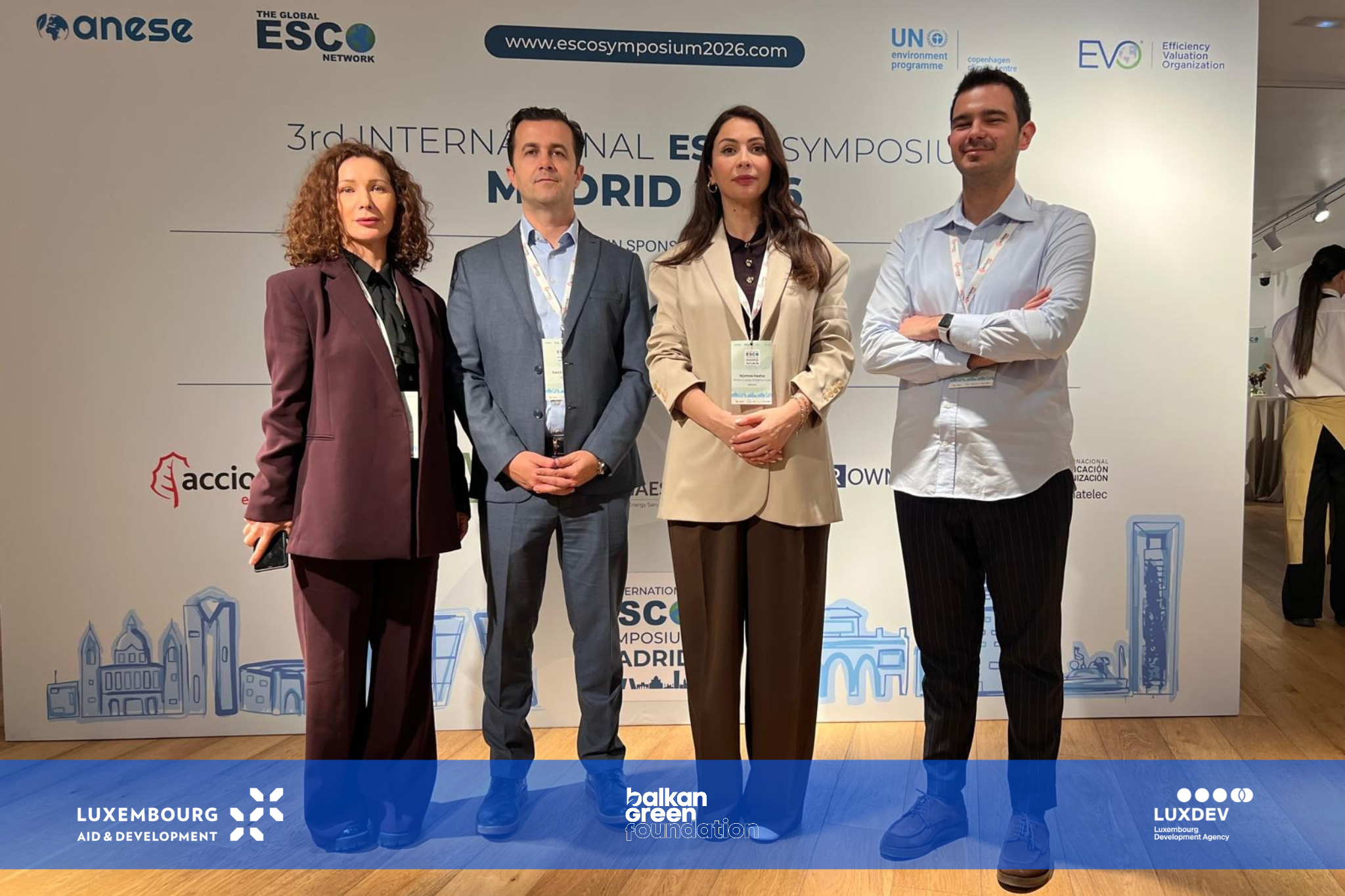
Balkan Green Foundation (BGF), with the support of LuxDev, led a Kosovo delegation to the 3rd International ESCO Symposium, held in Madrid on 20–21 October 2026. BGF organised the participation of the Kosovo Energy Efficiency Fund (KEEF), represented by its Managing Director and Operations Manager, together with LuxDev’s Capacity Development Expert.
The symposium was organised by ANESE and the Global ESCO Network and brought together policymakers, financial institutions and energy service companies (ESCOs), alongside representatives of the World Bank, the International Energy Agency (IEA), the European Investment Bank (EIB), the OECD and other international organisations.
BGF’s aim was to strengthen cooperation with the institutions responsible for energy efficiency in Kosovo and to bring international experience in financing and delivering energy efficiency investments closer to Kosovo’s own priorities.
Lessons from global ESCO markets
One message came up repeatedly in Madrid: technology is rarely the main obstacle to energy efficiency. The more difficult challenges are financing projects, clearly defining responsibilities, and ensuring that the promised energy savings are actually achieved.
Speakers from South Africa described the challenges of turning energy efficiency policies into projects that banks are willing to finance. Japan highlighted the situation of smaller energy service companies that may have the necessary technical expertise but lack the financial capacity to take on larger contracts.
Sessions involving the OECD, EIB and BASE Foundation explored performance contracting, ways of sharing risk between partners, and methods for reliably verifying energy savings. Discussions on Super ESCO models also examined how grouping smaller renovation projects can reduce costs and make them more attractive to investors.
For BGF, one of the clearest lessons was that financing models need to reflect local conditions. Approaches that work in countries with established ESCO markets cannot simply be copied elsewhere, including in Kosovo.
Kosovo’s experience on the international stage
Kosovo was included for the first time in the Global ESCO Market 2026 report, with a dedicated case study on KEEF and its public revolving fund.
Among the countries reporting energy savings data, Kosovo recorded the highest projected rate, at approximately 45%. While these are projected rather than independently verified savings, they demonstrate the potential of comprehensive energy efficiency improvements in public and residential buildings.
KEEF’s Managing Director also participated in a World Bank-moderated panel alongside representatives from Moldova and Azerbaijan, discussing national approaches to energy efficiency financing and the role of international financial institutions in developing ESCO markets.
From global lessons to local action
Kosovo’s strong projected savings show what energy efficiency can achieve. The next step is making sure more businesses and households can invest in it.
Under the Empowering Green Transition in Kosovo project, BGF supports municipalities in implementing energy efficiency measures and works with institutions to strengthen access to financing.
The lessons from Madrid on financing models, risk sharing and verifying energy savings are important for the further development of the financial mechanisms developed by LuxDev for SMEs and the residential sector in Kosovo. These mechanisms combine grants, own contributions and bank loans, an approach that reflects local conditions rather than copying models from established ESCO markets.
By strengthening municipal capacity and bringing institutions together around practical financing solutions, BGF works to ensure that Kosovo’s energy transition delivers real and measurable benefits for citizens.
The participation was supported through the Energy Transition and Climate Mitigation in Kosovo project, funded by the Grand Duchy of Luxembourg and implemented by LuxDev, the Luxembourg Development Cooperation Agency.