

← Press
Everything that happened at BGI 2026, and more
The 15th edition of the Balkan Green Ideas (BGI) regional competition took place from 3 to 5 November 2026 at the Innovation and Training Park (ITP) Prizren. Organised by Balkan Green Foundation (BGF), the regional competition brought together green entrepreneurs, partners, donors and participants from across the Western Balkans for three days of pitching, learning and networking.
Since its first edition in 2012, BGI has invested more than $500,000 in over 50 green ideas across the region, helping them grow into established businesses.
From national finals to a regional stage
The road to Prizren started months earlier, with national competitions in each of the six countries. Organised by BGI's national partners, American Academy of Technology Tirana in Albania, CENER 21 in Bosnia and Herzegovina, VentureUP in Kosovo, Green Home in Montenegro, ARNO in North Macedonia and Trag Foundation in Serbia, the national competitions gave young entrepreneurs the chance to present their green ideas and compete for a place at the regional final.
The best of them made it through. Sixteen green ideas, each already a national winner, arrived in Prizren to compete at the regional level in two categories: Advanced Idea and Concept Idea.
An opening with a strong message
BGI 2026 officially opened on 3 November with addresses from Mimoza Kusari-Lila, Minister of Industry, Entrepreneurship, Trade and Innovation, Dardan Sejdiu, Executive Director of Balkan Green Foundation, and Nermin Mahmuti, Executive Director of the Community Development Fund.
Minister Kusari-Lila spoke about the ministry's work in supporting entrepreneurs, including the development of eco-industrial parks and the establishment of an Innovation Fund, which aim to help businesses innovate, adopt greener technologies and become more competitive.
Dardan Sejdiu reflected on how far the programme has come. When BGI began in 2012, he said, talking about the green transition was still ahead of its time; fifteen editions later, it has become a platform for turning green ideas into real businesses and opportunities across the Western Balkans.
Nermin Mahmuti spoke about the Green Horizons project, through which CDF supports this year's edition, and about CDF's partnership with Balkan Green Foundation in supporting green entrepreneurship in Kosovo and the region.
A jury with international experience
This year's finalists pitched in front of an international jury that brought together experience from philanthropy, business education and start-up acceleration.
Danièle Castle, Board Member of Helvetas and Co-Director of the MAS in Philanthropy at the University of Geneva, brought years of experience in international development and philanthropy, and a clear view of what it takes for an idea to attract support and create lasting impact. Prof. Mislav Ante Omazić, Acting Dean of IEDC – Bled School of Management, brought the perspective of business education and responsible leadership, helping finalists think about how their businesses can grow in a sustainable and socially responsible way. Georgi Georgiev, Program Director of Elevate Accelerator at the American University in Bulgaria, brought hands-on experience in supporting early-stage start-ups, with a sharp eye for what makes a business ready to scale.
Together, they gave every finalist valuable questions, feedback and insight to take home, whatever the final result.
The private sector gets involved
This year also marked a new development for the programme. For the first time, two donors from Kosovo's private sector, the Kosovo Financing Agency (AFK) and Rugove Corporation, joined BGI as supporters, alongside the longstanding support of the Rockefeller Brothers Fund. This is a strong sign that green entrepreneurship in the region is increasingly seen not only as worth promoting, but as worth supporting.
We are grateful to everyone who made BGI 2026 possible: our donors and partners, our national partner organisations, our jury and speakers, our finalists, everyone who joined us in Prizren, and our volunteers. Fifteen editions in, we are already looking forward to the next one.
Two days of pitching
Every BGI story starts with a pitch. Over two days, on 3 and 4 November, the finalists took the stage one by one, with ten minutes each to present their idea and convince the jury why it deserves to grow.
We heard about water saved on family farms, lost water traced in buildings, a rover that scouts crops, microgreens grown in the city, textiles turned into building blocks, linen bedding, clothes given a second life, plastic turned into handbags and toys, old electronics recovered, brewing machines that warn before they fail, green arbours that cool city squares, homes for wild bees and mountain villages brought closer to visitors.
The sessions were full of energy. Finalists presented bold ideas and real solutions to environmental challenges, answered tough questions from the jury, and showed exactly why their businesses matter for the environment, for their communities and for the region's future.
BGI Talks
Between the pitches, three BGI Talks gave finalists and guests new perspectives on building a green business.
The first BGI Talk was with Danièle Castle, who presented the role of Helvetas globally and spoke about the importance of diversified finance models in a time of budget shortfalls. As traditional funding becomes harder to secure, combining different sources of support is key for organisations and green businesses to stay resilient.
In the second talk, "How do banks fund start-ups?", Mimoza Pasha from the Kosovo Financing Agency (AFK) spoke about how entrepreneurs should approach investors. Her message was clear: short-term earnings are not sustainable, and financial gain should not be the main factor behind a business. What matters is the long-term value it creates, including its social and environmental impact.
The third and last talk, with Prof. Mislav Ante Omazić, was a different kind of talk. Instead of a classic lecture, he let his slides do the talking, using striking photos, sayings and graphics to talk about something every entrepreneur faces: the fear of failure. Nearly half of adults worldwide say that fear would stop them from starting a business, yet every successful entrepreneur has failed along the way, often many times. His message to the finalists was simple: a setback only becomes a mistake if we learn nothing from it. The moment we learn something, it becomes a lesson, and that is how good ideas grow into successful businesses.
The programme also took participants beyond the stage, with a visit to DokuFest, the International Documentary and Short Film Festival in Prizren. The DokuFest team shared the story of their 25 years, and participants watched the official teaser of their 25th edition and the Kosovan film "Në mes" by Samir Karahoda.
And the winners are…
On 5 November, after a morning of speed networking for the finalists and a meeting of BGI's strategic partners, the long-awaited moment arrived: the announcement of the winners of BGI 2026. Fjolla Qorri, Programs Development Manager at Balkan Green Foundation, announced the winners and highlighted that Balkan Green Foundation, through BGI, invests in the people who see this potential and are prepared to act on it.
Congratulations to all three winners, and to every finalist who took the stage in Prizren. Each of them has already shown what green entrepreneurship in the Western Balkans can look like. In her closing remarks, Fjolla reminded the finalists that it takes courage to present an idea to a jury and a room full of new faces, and that all sixteen teams will remain part of the BGI network. For the three winners, the next step is working closely with the BGF team throughout the year to scale up their ideas.
The 2026 edition of Balkan Green Ideas is supported by the Rockefeller Brothers Fund, as well as through the project "Green Horizons - Community Engagement through Advancing Sustainable Energy", implemented within the EECSOK project by the Community Development Fund (CDF) and funded by the Swedish International Development Cooperation Agency (Sida). The Regional Competition is additionally supported by the Kosovo Financing Agency and Rugove Corporation.
Since its first edition in 2012, BGI has invested more than $500,000 in over 50 green ideas across the region, helping them grow into established businesses.
From national finals to a regional stage
The road to Prizren started months earlier, with national competitions in each of the six countries. Organised by BGI's national partners, American Academy of Technology Tirana in Albania, CENER 21 in Bosnia and Herzegovina, VentureUP in Kosovo, Green Home in Montenegro, ARNO in North Macedonia and Trag Foundation in Serbia, the national competitions gave young entrepreneurs the chance to present their green ideas and compete for a place at the regional final.
The best of them made it through. Sixteen green ideas, each already a national winner, arrived in Prizren to compete at the regional level in two categories: Advanced Idea and Concept Idea.
An opening with a strong message
BGI 2026 officially opened on 3 November with addresses from Mimoza Kusari-Lila, Minister of Industry, Entrepreneurship, Trade and Innovation, Dardan Sejdiu, Executive Director of Balkan Green Foundation, and Nermin Mahmuti, Executive Director of the Community Development Fund.
Minister Kusari-Lila spoke about the ministry's work in supporting entrepreneurs, including the development of eco-industrial parks and the establishment of an Innovation Fund, which aim to help businesses innovate, adopt greener technologies and become more competitive.
Dardan Sejdiu reflected on how far the programme has come. When BGI began in 2012, he said, talking about the green transition was still ahead of its time; fifteen editions later, it has become a platform for turning green ideas into real businesses and opportunities across the Western Balkans.
Nermin Mahmuti spoke about the Green Horizons project, through which CDF supports this year's edition, and about CDF's partnership with Balkan Green Foundation in supporting green entrepreneurship in Kosovo and the region.
A jury with international experience
This year's finalists pitched in front of an international jury that brought together experience from philanthropy, business education and start-up acceleration.
Danièle Castle, Board Member of Helvetas and Co-Director of the MAS in Philanthropy at the University of Geneva, brought years of experience in international development and philanthropy, and a clear view of what it takes for an idea to attract support and create lasting impact. Prof. Mislav Ante Omazić, Acting Dean of IEDC – Bled School of Management, brought the perspective of business education and responsible leadership, helping finalists think about how their businesses can grow in a sustainable and socially responsible way. Georgi Georgiev, Program Director of Elevate Accelerator at the American University in Bulgaria, brought hands-on experience in supporting early-stage start-ups, with a sharp eye for what makes a business ready to scale.
Together, they gave every finalist valuable questions, feedback and insight to take home, whatever the final result.
The private sector gets involved
This year also marked a new development for the programme. For the first time, two donors from Kosovo's private sector, the Kosovo Financing Agency (AFK) and Rugove Corporation, joined BGI as supporters, alongside the longstanding support of the Rockefeller Brothers Fund. This is a strong sign that green entrepreneurship in the region is increasingly seen not only as worth promoting, but as worth supporting.
We are grateful to everyone who made BGI 2026 possible: our donors and partners, our national partner organisations, our jury and speakers, our finalists, everyone who joined us in Prizren, and our volunteers. Fifteen editions in, we are already looking forward to the next one.
Two days of pitching
Every BGI story starts with a pitch. Over two days, on 3 and 4 November, the finalists took the stage one by one, with ten minutes each to present their idea and convince the jury why it deserves to grow.
We heard about water saved on family farms, lost water traced in buildings, a rover that scouts crops, microgreens grown in the city, textiles turned into building blocks, linen bedding, clothes given a second life, plastic turned into handbags and toys, old electronics recovered, brewing machines that warn before they fail, green arbours that cool city squares, homes for wild bees and mountain villages brought closer to visitors.
The sessions were full of energy. Finalists presented bold ideas and real solutions to environmental challenges, answered tough questions from the jury, and showed exactly why their businesses matter for the environment, for their communities and for the region's future.
BGI Talks
Between the pitches, three BGI Talks gave finalists and guests new perspectives on building a green business.
The first BGI Talk was with Danièle Castle, who presented the role of Helvetas globally and spoke about the importance of diversified finance models in a time of budget shortfalls. As traditional funding becomes harder to secure, combining different sources of support is key for organisations and green businesses to stay resilient.
In the second talk, "How do banks fund start-ups?", Mimoza Pasha from the Kosovo Financing Agency (AFK) spoke about how entrepreneurs should approach investors. Her message was clear: short-term earnings are not sustainable, and financial gain should not be the main factor behind a business. What matters is the long-term value it creates, including its social and environmental impact.
The third and last talk, with Prof. Mislav Ante Omazić, was a different kind of talk. Instead of a classic lecture, he let his slides do the talking, using striking photos, sayings and graphics to talk about something every entrepreneur faces: the fear of failure. Nearly half of adults worldwide say that fear would stop them from starting a business, yet every successful entrepreneur has failed along the way, often many times. His message to the finalists was simple: a setback only becomes a mistake if we learn nothing from it. The moment we learn something, it becomes a lesson, and that is how good ideas grow into successful businesses.
The programme also took participants beyond the stage, with a visit to DokuFest, the International Documentary and Short Film Festival in Prizren. The DokuFest team shared the story of their 25 years, and participants watched the official teaser of their 25th edition and the Kosovan film "Në mes" by Samir Karahoda.
And the winners are…
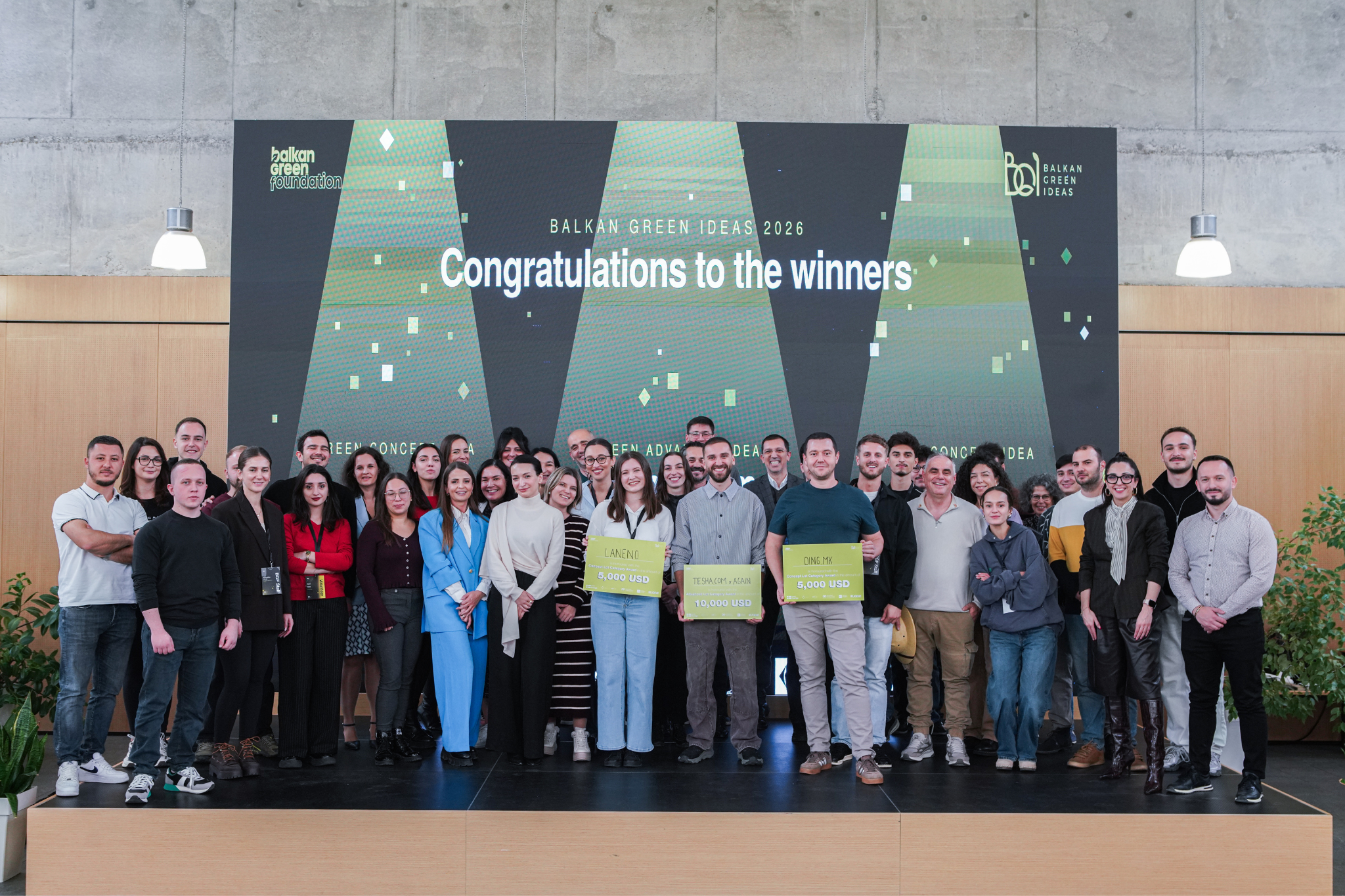
On 5 November, after a morning of speed networking for the finalists and a meeting of BGI's strategic partners, the long-awaited moment arrived: the announcement of the winners of BGI 2026. Fjolla Qorri, Programs Development Manager at Balkan Green Foundation, announced the winners and highlighted that Balkan Green Foundation, through BGI, invests in the people who see this potential and are prepared to act on it.
- Advanced Idea: Teshat.com x Again, Kosovo ($10,000)
- Concept Idea: Laneno, Bosnia and Herzegovina ($5,000)
- Concept Idea: ding.mk, North Macedonia ($5,000)
Congratulations to all three winners, and to every finalist who took the stage in Prizren. Each of them has already shown what green entrepreneurship in the Western Balkans can look like. In her closing remarks, Fjolla reminded the finalists that it takes courage to present an idea to a jury and a room full of new faces, and that all sixteen teams will remain part of the BGI network. For the three winners, the next step is working closely with the BGF team throughout the year to scale up their ideas.
The 2026 edition of Balkan Green Ideas is supported by the Rockefeller Brothers Fund, as well as through the project "Green Horizons - Community Engagement through Advancing Sustainable Energy", implemented within the EECSOK project by the Community Development Fund (CDF) and funded by the Swedish International Development Cooperation Agency (Sida). The Regional Competition is additionally supported by the Kosovo Financing Agency and Rugove Corporation.